
Why does a fulfillment failure stay invisible?
Every week, between 5,000 and 15,000 execution failures slip through a large retail operation. Late, wrong, split, cancelled. The team can investigate fewer than one percent of them.
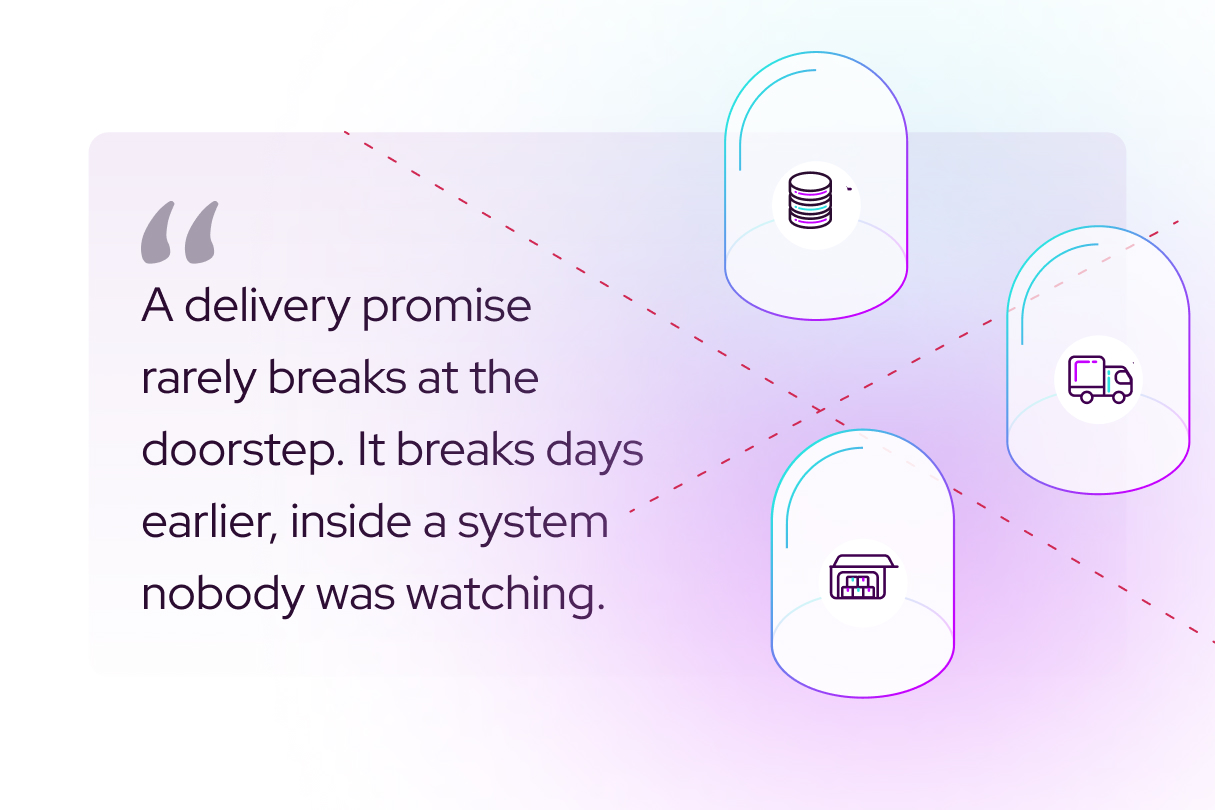
That is not a discipline problem. The root cause of a single failure typically spans three to five systems, buried across the fifteen to twenty systems a retailer already runs.
So the work stalls in three predictable places. Data gets centralised but never analysed. What is analysed is not understood. What is understood is never actioned. A rule can fire on a threshold. It cannot read a carrier feed, a warehouse exception and a support ticket and work out that all three are the same event.
What does one of these failures actually look like?
An order is picked short on a Tuesday because a bin count was wrong. The warehouse logs an exception. The order management system splits the shipment rather than holding it. The carrier scans the first parcel and the promise date quietly recalculates. The customer gets one box on Thursday and the second the following Monday. Support closes a ticket about a missing item.
Five systems. Five accurate records. Not one of them says the promise was broken. Nobody was negligent. The event simply never existed in one place.
Resolving that takes two things a threshold cannot do. Signal fusion, which reads those five records as one stream. And entity resolution, which proves the bin count, the split, the carrier scan and the ticket all belong to the same order and the same root cause.
What does it cost when the promise breaks?
The cost of an execution failure is not a complaint. It is a customer who does not come back.
That lands on a specific P&L line, and Beamup's Promise & Service Level agent owns it: SLA credits, chargebacks, cancellations, lost sales. Downstream it turns up in repeat purchase, NPS and subscription churn. A fulfillment number and a loyalty number are usually the same number, read at different times.
Most retail leaders already know the aggregate. The daily miss count arrives on time. What is missing is the reason behind any individual one of them, early enough to act, which is the only version of that number that changes anything.
How do you find the root cause across WMS, TMS, OMS and CRM?
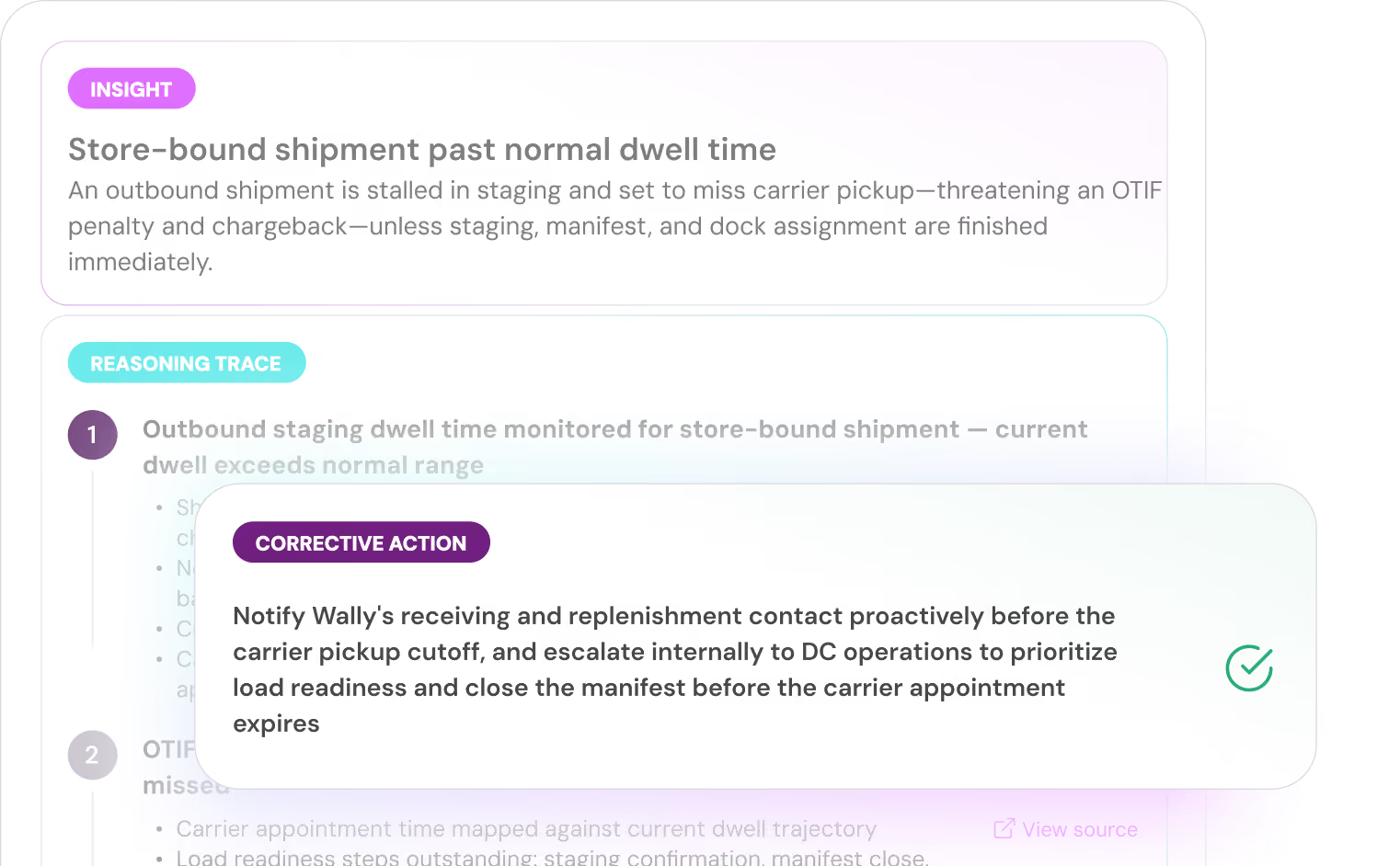
A dedicated agent reads the signals across those systems, resolves them to one order and one event, and proves which system caused the miss. Then it takes the corrective action. Find it. Prove it. Fix it.
It works on the data as it stands. Missing fields, duplicate records and inconsistent naming across systems are the normal condition of a retail estate, not something to clean up before starting.
Customers see resolution time move from hours to seconds, and a 20 percent reduction in shrink and concessions. Building the equivalent in house is roughly three years and fifty engineers.



.jpg)