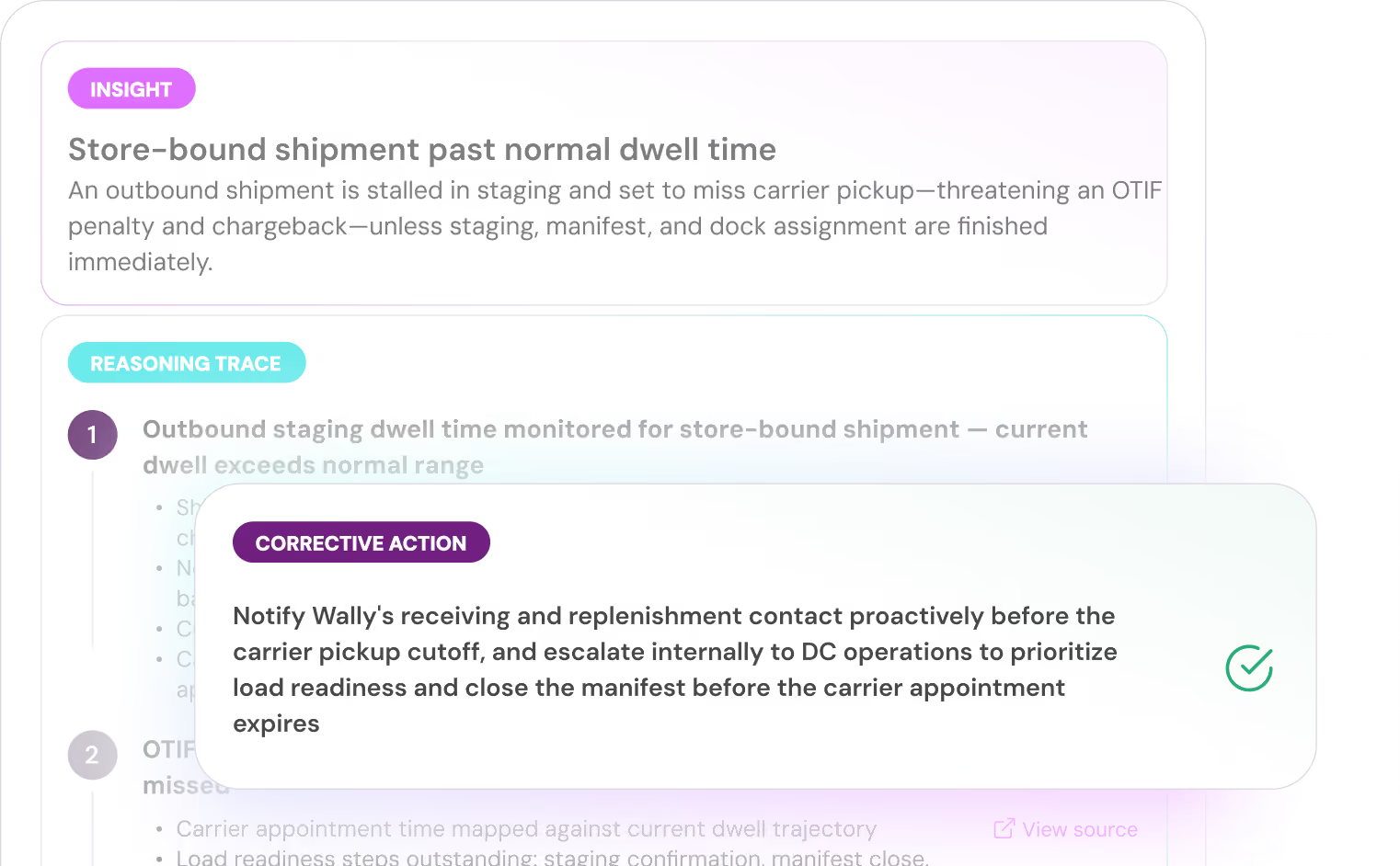
Automated storage sites log pick and cycle-count shortfalls all day, and most come from process errors, with a minority from theft. Flagging every one gives investigators mostly false positives, and the camera footage for a real case is overwritten after a short retention window.
Not enough staff. A loss-prevention team cannot manually triage every pick or cycle-count shortfall across an automated storage network. Most are process errors, so a single-signal alert on each one gives investigators mostly false positives and hides genuine theft.
Disconnected systems. Investigators cannot tell theft from process loss because the signals that separate them sit in different systems: value and product risk, pattern history, storage touch activity, and operational checks. No one connects them before the camera footage expires.
48.4% → 61.5%
Investigation-outcome rate across the loss-prevention region
4.7%
Peak theft-conversion rate on the highest-signal automated storage touch band
30
Confirmed person-of-interest separations year-to-date, vs. a 120-separation program goal
Find it
Our forward-deployed engineers connect the systems you already run and turn scattered data into one view. Agents then cut thousands of signals down to the few that matter.
Prove it
The agent assembles evidence for one failure across systems that never agree, puts a dollar value on it, and shows its reasoning with linked sources.
Fix it
A finding isn't a fix. The agent takes corrective action, and our engineers build it into your existing tools, so the solution is autonomous instead of arriving as another report.
01 Find it
A pick shortfall (an item expected in the bin but not there when the picker arrives) or a cycle-count discrepancy (physical count short of system count) both show that something is missing without saying why. Most of the time the cause is benign, so Beamup alerts only when several independent signals line up around the same discovery event. Each alert that reaches an investigator therefore has a case behind it.
- Value & product context – dollar value, concealability, and a high-risk-product flag
- Pattern signals – repeated shortfalls in similar stages, recurring item patterns, deviation from baseline
- Automated storage touch activity – a lead-quality signal unique to automated storage sites
- Operational-context checks – rule out item found elsewhere, label swap, pack error, forced pick, deletion error
- Timing check – confirms the event still falls inside the camera-retention window, so the lead is actually investigable
Beamup agents weigh these signals together against every pick and cycle-count shortfall before surfacing anything, so an investigator sees only the leads where value, pattern, and operational context all point to theft.
A Beamup forward-deployed engineer embeds with the operator's loss-prevention and data teams. The engineer wires in the pick, count, stow, product, and touch data, calibrates the convergence logic against the site's real event history, and tunes the process-versus-theft separation to how each building runs. Because the thresholds are fitted to the site before go-live, the program runs on data the operator already produces, with no new hardware or cameras.
02 Prove it
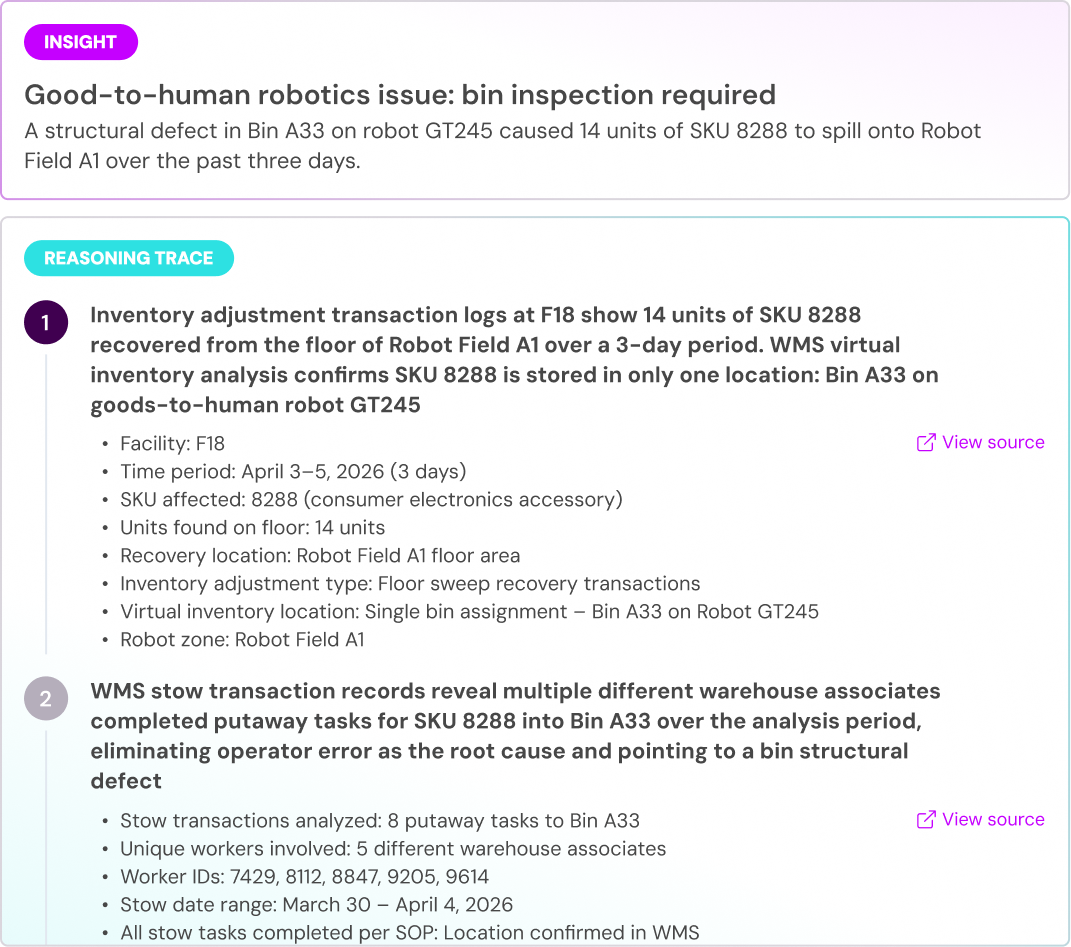
The hard part of this mission is telling a theft from the many ordinary ways inventory goes missing on its own. Before the agent escalates a shortfall, it checks whether a known operational cause explains it, such as a counting error, a stow or pick mistake, an item found in a non-standard location, a master-pack issue, or a vendor shipment discrepancy, and it sets aside every shortfall that one explains. Every insight that escalates carries its full evidence trail, so an investigator can see why it was raised.
Once the model was tuned for precision, the investigation-outcome rate rose from 48.4% to 61.5%, and the share of investigations confirmed or still ongoing rose from 10.0% to 18.6%.

03 Fix it
The Beamup agent takes on the groundwork that used to consume investigators’ time. It sets aside shortfalls that a process cause explains, holds back any lead whose footage has expired, ranks the rest by value and signal strength, and assembles the evidence behind each one before an investigator opens it. The investigator reviews the evidence, records findings, and closes each insight as an investigation outcome or a business-process issue, and the agent makes no decision about an individual.
Open the insight from the queue; review overview and properties

Review the touch timeline
Research stow time and activity; verify against footage
The Bottom Line
Loss-prevention tooling that alerts on every shortfall gives investigators mostly process losses to sort through, and the real theft gets lost among them. This program requires value, pattern, automated storage touch activity, and operational context to converge, and it rules out a process explanation first. The result is a shorter queue of credible leads, each with its full evidence trail and each released while it can still be investigated. Across the operator’s automated storage region, more of those leads are now reaching real conclusions and confirmed separations, and the program names no individual until a human has verified an explainable lead.
Related Loss Events
Apply the same convergence logic to adjacent loss types — receiving, transshipment, and return-related shortfalls — where process and theft look alike at first glance.
Process-Error Analytics
Turn the suppressed business-process bucket into its own product — ranking where operational errors cluster, so the operator fixes the process, not just the symptom.
Network-Wide Rollout
Extend site by site across the automated storage network, each onboarding calibrated to its own patterns and each jurisdiction’s and privacy constraints.