
In a high-throughput distribution center X dwell events are happening in one month. For this provider only 5 events like this were investigated to success.
High volume. Thousands of units cross seven scan milestones a day. No team can watch each one closely enough to catch it going still.
Disconnected systems. Receiving, putaway, wave, pack, sort, and carrier logs each capture one scan alone — none tied to the deadline it's racing.
fewer late-cutoff breaches
detection latency
less "Where’s My Order" CS Contacts
Find it
Our forward-deployed engineers connect the systems you already run and turn scattered data into one view. Agents then cut thousands of signals down to the few that matter.
Prove it
The agent assembles evidence for one failure across systems that never agree, puts a dollar value on it, and shows its reasoning with linked sources.
Fix it
A finding isn't a fix. The agent takes corrective action, and our engineers build it into your existing tools, so the solution is autonomous instead of arriving as another report.
01 Find it
In a high-throughput distribution center, freight rarely goes missing, it goes still. A pallet sits on the dock after its receiving scan with no putaway task. A packed order never scans into the sorter. A ship label prints and then nothing moves. Each of these is a dwell event: a unit that has not progressed from one scan milestone to the next inside its SLA window, and every one of them is a breach waiting to happen.
Beamup agents apply dwell-detection logic across the full value stream. It draws timestamp and status data from the systems the facility already runs — no new hardware, no new scanners:
Beamup starts a timer on each unit at its first scan and tracks whether the next expected scan lands inside its SLA window — turning scattered feeds into one continuous, real-time picture of what is stuck and where.
Beamup forward-deployed engineer embeds with the customer's operations and data teams to map these sources to the site's actual scan behavior, set the SLA thresholds each milestone is measured against, and tune the logic to how this building really runs. That hands-on onboarding is what makes the detection accurate from day one rather than a generic ruleset — and it is why the program went live on data the facility already produces, without a hardware project.
02 Prove it
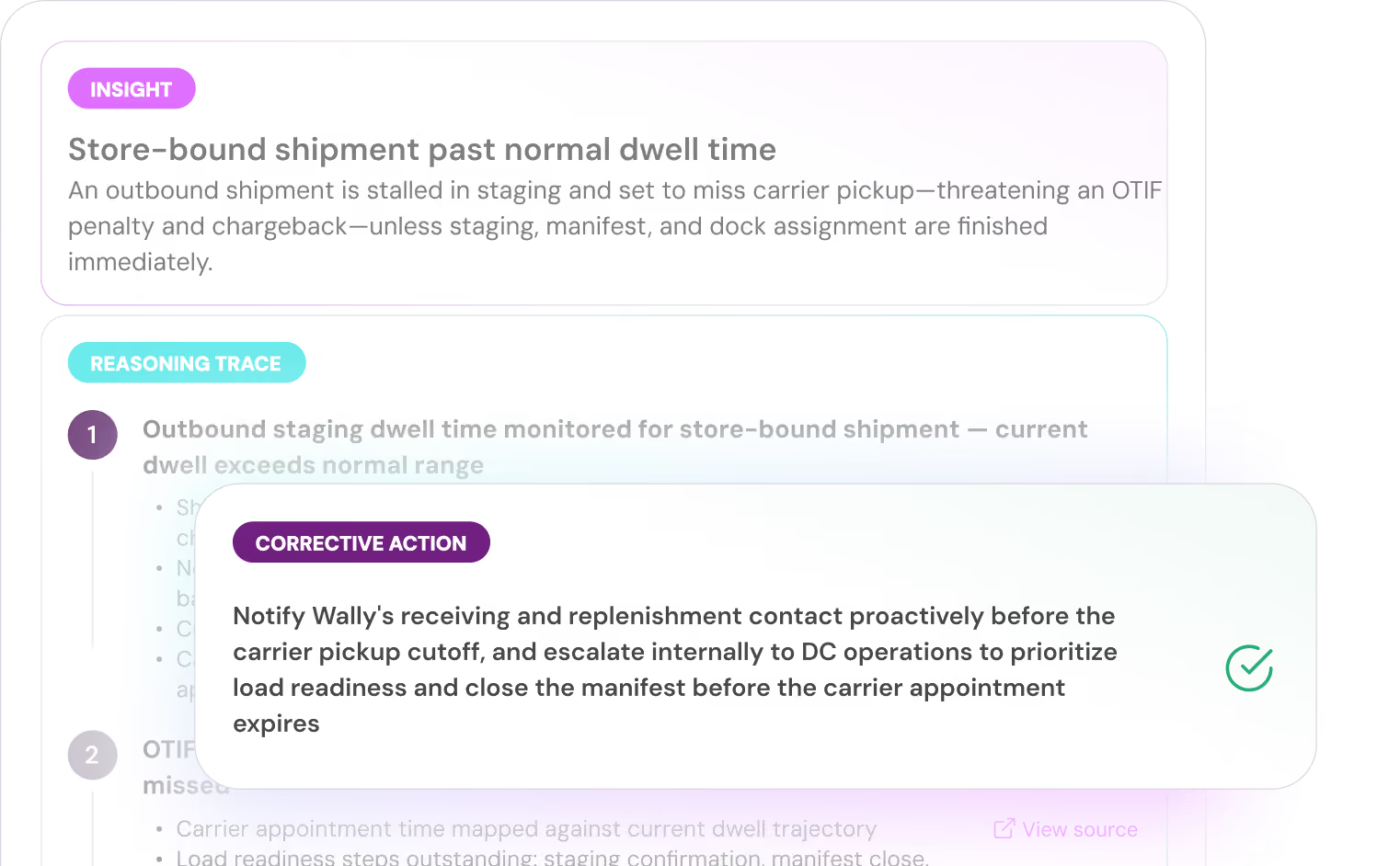
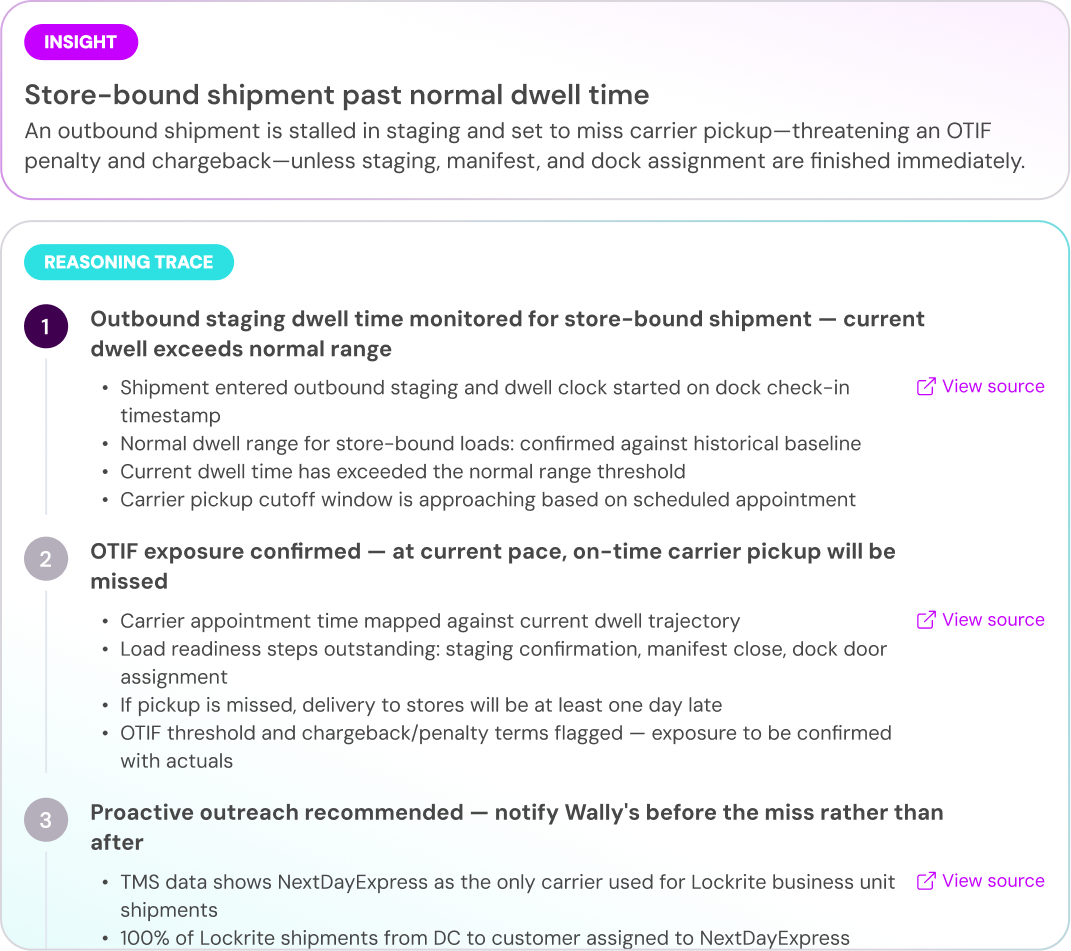
A late scan is not automatically a problem — a raw exception feed of every unit slightly behind pace would bury supervisors and get ignored. Beamup surfaces an alert only when a unit has genuinely stalled past its SLA window, anchored to the right reference point: inbound dwell is measured putaway-against-receiving; outbound dwell is measured against the carrier cutoff time (CPT), the anchor every downstream step is scheduled backward from.
Context then decides urgency. The same signals that detect the stall also rank it — a stalled pallet carrying a zero-stock SKU, or an order about to miss its truck, escalates ahead of one with slack still in the schedule.
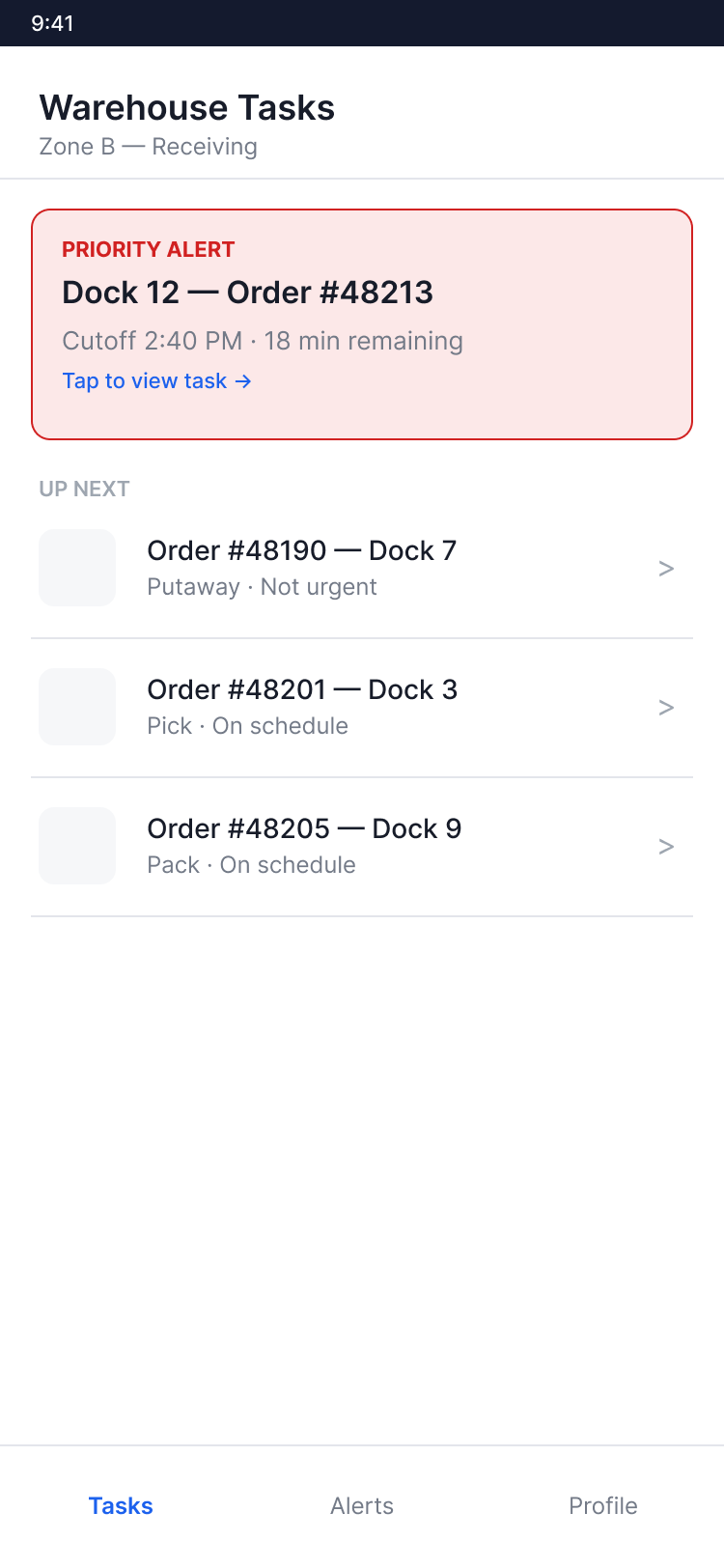
The result is a short, prioritized list of units that actually need intervention, each carrying the detail a supervisor needs to act: pallet or order ID, dock door, elapsed time, and the assigned associate.
The result is a short, prioritized list of units that actually need intervention, each carrying the detail a supervisor needs to act: pallet or order ID, dock door, elapsed time, and the assigned associate.

03 Fix it
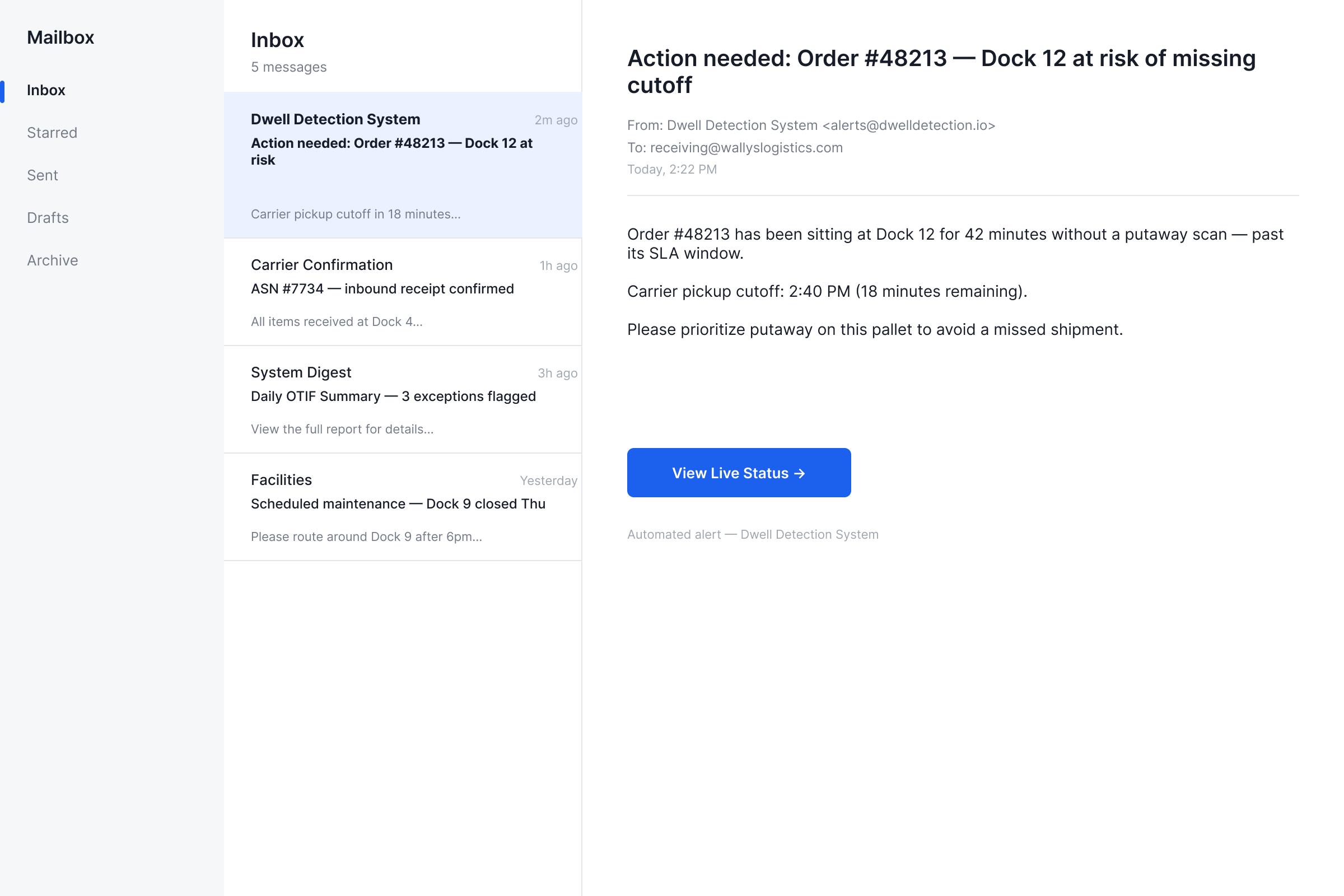
When a unit stalls, the fix is operational, not technical. Beamup surfaces every dwell alert as a near-real-time push notification inside the Beamup platform — routed to the shift supervisor with pallet or order ID, dock door, elapsed time, and assigned associate, so the intervention is a specific action on a specific unit rather than a hunt. No new scanners, no new WMS: the program reads the scan data the facility already generates.
Beamup is deliberately scoped to notifications first. As the customer gains confidence in alert precision, the platform layered workflow triggers as a fast follow — auto-created recovery tasks — and, when the customer is ready, fully agentic actions. The dwell logic is also built to scale to additional sites with minimal configuration change.
Notify Wally's receiving/replenishment contact
Escalate internally to DC ops — prioritize load readiness
Close the manifest before the carrier appointment expires
.png)
The Bottom Line
For years, stalled freight was invisible until the end of each shift — by which point a missed carrier cutoff was already a fact, not a risk. What changed is not more staff or new hardware; it is that the scan data the facility already produces is finally read continuously and in context. A forward-deployed Beamup engineer wired the site's own WMS, OMS, TMS, and yard signals into one live timeline, set the SLA thresholds that define a true stall, and tuned the logic to how this building actually runs. That is what turned an end-of-shift post-mortem into a near-real-time save — detecting a stall inside ~30 minutes and putting a specific, prioritized action in a supervisor's hands while there is still time to act.

Healthcare & Pharma
Flag temperature-sensitive or controlled shipments dwelling too long at a staging step before a cold-chain or compliance window closes — protecting product and chain-of-custody.

Manufacturing
Catch work-in-progress or inbound components stalled between production stations, protecting just-in-time line-side sequencing before the line starves.

Air & Parcel Hubs
Detect packages dwelling past a sort cutoff so they make the outbound flight or linehaul instead of missing the connection and cascading into delays.